

Four units used to feel like plenty. Now you’re looking at listings for five-unit buildings, maybe a six, maybe even a nine, and the jump makes sense. You’ve done this before. What you might not have done is finance something this size, and that part doesn’t always go the way it did with the single-family rental or the duplex.
Finding a lender usually isn’t the problem for someone with a few properties behind them. The tricky part is landing a loan that pays attention to how the building actually rents, and also gives weight to your experience, your credit, your assets, and what you’re trying to do.
DG Funding has a DSCR program for properties with five or more units. That gives you another path when you’re growing a portfolio. The program itself, the math behind it, and the stuff to have ready before you apply are all in this blog post.
What Changes When You Move to 5+ Units?
At five units, the lender starts caring a lot more about how the property performs and how it’s run.
Rental income and cash flow get a close look. So do the property’s value, your track record as a borrower, your credit, and what assets you’ve got available. You’ll also be asked for details on the building’s performance and its operating costs.
Which is why it pays to show up prepared. A building with strong rents can look like a sure thing at first. But the decision rests on how the lender reads the income and the debt, and how much risk it sees overall.
Maybe you’re buying your next multifamily property. Maybe you want to refinance one you already own, or pull cash out to put toward a bigger plan. Any of those could be a good reason to look at a DSCR loan with DG Funding.
DG Funding’s 5+ Unit DSCR Loan: Key Program Details
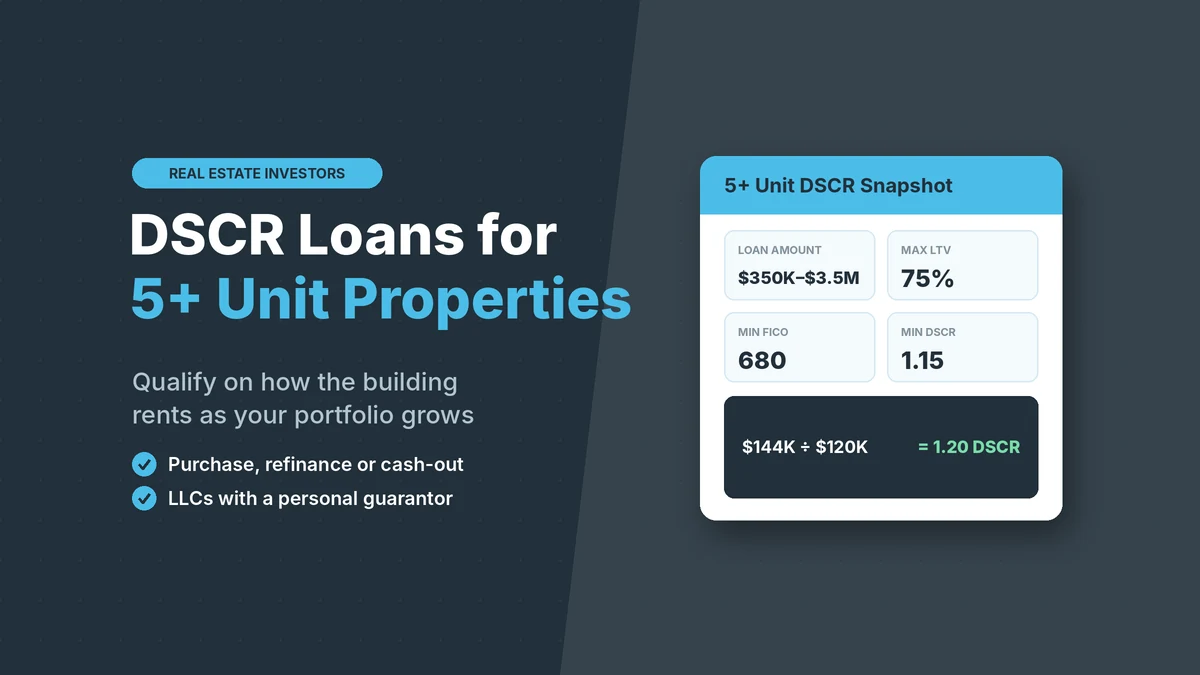
Here’s where we start for qualifying properties with five or more units:
| Program feature | Guideline |
|---|---|
| Loan amount | $350,000 to $3.5 million |
| Maximum loan-to-value (LTV) | Up to 75% |
| Minimum credit score | 680 FICO |
| Minimum debt service coverage ratio (DSCR) | 1.15 |
| Required reserves | 6 months of PITIA on the subject property |
| Maximum cash-out | $500,000 |
| Seller concessions | Up to 3% toward closing costs |
| Entity borrowers | LLCs permitted with a personal guarantor |
You’ve got a few loan structures to pick from. A 30-year fixed rate is one. There’s also a 30-year fixed with interest-only and a 5/6 adjustable-rate mortgage (ARM). The ARM also comes with an interest-only option.
Worth saying plainly: these are published parameters, not a promise. Approval isn’t guaranteed, and some options won’t be available on some deals. Underwriting and the property’s specifics decide the final terms.
The loan range runs from $350,000 up to $3.5 million. If you’re thinking somewhere around $750,000 to $2.5 million, you’re well within the published limits, which is good news. It doesn’t settle things, though. The property’s value, leverage, cash flow, and the other eligibility factors all still need to work.
How DSCR Works: Does the Property Support the Debt?
DSCR means debt service coverage ratio. The basic idea is a comparison between the income the lender recognizes for a property and the debt service on that property.
For this program, the minimum DSCR is 1.15. When we do our income-to-debt-service calculation, the number it gets has to meet or beat that threshold.
It’s easier to see with numbers.
Let’s say we put a property’s qualifying annual income at $144,000. Annual debt service comes to $120,000.
Illustrative DSCR calculation:
$144,000 ÷ $120,000 = 1.20
So the DSCR is 1.20. That clears the 1.15 minimum with some room to spare.
Take the qualifying income down to $138,000 and leave debt service at $120,000:
$138,000 ÷ $120,000 = 1.15
That one squeaks by, at least in this simplified version.
Here’s the catch, and it matters. The lender is the one who decides which income and debt-service figures go into the calculation. Rents, operating expenses, and the program’s method can all move the number. Gross rent often isn’t your qualifying income, so don’t plan around it like it is.
Before you put in an offer, ask for an assessment that uses the property’s actual financials and whatever underwriting method applies.
Could Interest-Only Financing Help Your Portfolio?
Plenty of investors pick interest-only because it makes near-term cash flow easier to handle. With DG Funding’s 5+ unit program, you can get it with the 30-year fixed or the 5/6 ARM.
For as long as the interest-only period lasts, your scheduled payments can come in lower, since the monthly installments aren’t touching principal. That leaves more cash for improvements, reserves, or the next deal that catches your eye.
Smaller early payments don’t make the loan cheaper, though. During the interest-only stretch, principal generally doesn’t budge, at least not through scheduled payments. Once principal repayment kicks in, the payment can climb. If it’s an adjustable rate, the interest rate may also change, based on the loan terms.
The first payment is only part of the story. Look at where it starts and where it might end up. Think about how much rate risk you’re taking on, and whether the loan actually suits your plan. Interest-only can be a useful tool. It can’t rescue a property that doesn’t cash flow by itself.
“Isn’t a Five-Unit Property Just a Small Commercial Deal?”
Five units does get more scrutiny than most smaller residential rentals. No argument there. That still doesn’t mean every financing option follows the same process or wants the same things from you.
The 5+ unit DSCR program from DG Funding puts the property’s rental performance front and center. Your credit, assets, and experience get looked at too, and so does the property’s value.
Expect to hand over real paperwork. Rental income, leases, operating expenses, property details, and your own information help a lender figure out the deal.
With a DSCR-focused option, qualifying starts with how the property performs. Whether it’s the right fit comes down to the building, the numbers, and your overall financial picture.
Your 5-9 Unit Loan Preparation Checklist
Gather what you can before asking for a review:
- Property details: Address, unit count, property type, purchase price or estimated value.
- Rental information: Current rent roll, leases, occupancy details, and rental income.
- Operating expenses: Property taxes, insurance, maintenance, management costs, and other relevant expenses.
- Existing debt: Current mortgage balance and payment details if you’re refinancing or going for cash out.
- Borrower profile: Credit information, investment experience, and related financial details.
- Ownership structure: Individual or LLC ownership, and personal guarantor information if that applies.
- Liquidity and reserves: Available assets and any funds you might need to meet reserve requirements.
- Transaction goals: Purchase, refinance, portfolio expansion, or cash-out financing.
You don’t have to run every underwriting number yourself first. The point is to have enough for a real first look, so missing pieces turn up early rather than at the worst possible moment.
Grow Your Portfolio Today
Heading into the five+ unit range? Size up the property and the financing at the same time instead of one and then the other.
DG Funding can go over the loan amount you have in mind, the property’s income and operating expenses, how you own it, and what you’re aiming for. Then we can help you judge whether the 5+ unit DSCR program fits the deal.
Contact us today to talk about your next purchase, a refinance, or an eligible cash-out scenario. Have your rent roll handy, along with the property value or purchase price, current debt details if there are any, and ownership information. It keeps the conversation focused on your deal and not a hypothetical one.
From here, growing your portfolio is mostly about finding financing that matches how the property performs and where you want to end up over the long haul.