

Closing costs have a way of souring a good refinance offer. Maybe you’ve found a lower rate. Maybe the new payment looks better, or you’re planning a cash-out refinance to tap some equity. Then you see the upfront number, and it’s thousands of dollars you’d have to bring to the table.
So it makes sense that a lot of California homeowners go looking for a no closing cost refinance in California. Just know going in that “no closing costs upfront” and “no closing costs” aren’t the same thing.
What you actually want to figure out is whether paying those costs yourself or taking a lender-credit option works out better for you.
At DG Funding, we help borrowers compare mortgage structures by looking at their goals, their cash flow, and how long they’ll likely keep the loan, not only the advertised rate.
What Does a No Closing Cost Refinance Actually Mean?
Usually, it means you don’t pay certain eligible closing costs out of your own pocket at closing. Those costs get covered by lender credits or rolled into the new loan. Which one depends on how the deal is set up.
They aren’t the same, though.
Option 1: Lender credits
Here, the lender pays eligible closing costs. In return, you take a higher interest rate than you’d likely get if you covered those costs yourself.
Say you’re looking at two refinance offers. One has a lower rate and $5,000 in eligible closing costs. The other has a higher rate, plus enough lender credits to cover those costs.
The second one means less cash upfront. The higher rate, though, may push your monthly payment up.
Option 2: Financing the closing costs
You can also add eligible costs to your new mortgage balance, if your loan program and your equity allow it.
Let’s say you refinance a $700,000 mortgage and finance $5,000 in eligible costs. Your new balance could end up at $705,000.
No upfront payment for those costs. But you’re borrowing more, and you may pay interest on that extra amount for years. Loan-to-value limits and underwriting rules can also restrict this option.
What about prepaid expenses?
This is where it gets a bit more interesting. It’s also where homeowners could save even more.
Property taxes, homeowners insurance premiums, prepaid interest, that first deposit into escrow. None of these always has to come out of your pocket. Depending on how your loan is set up, lender credits can cover them too.
So say your insurance premium needs paying, or property taxes are coming due. Those costs may be handled with lender credits, so you don’t have to bring extra cash to closing.
Used strategically, credits like this could save you anywhere from $2,000 to $15,000 in out-of-pocket costs.
Don’t assume a “no closing costs” refinance stops at lender and third-party fees. Ask us how credits can go toward both closing costs and prepaid expenses. Then read through your written Loan Estimate and Closing Disclosure so you know exactly what’s covered.
The Break-Even Point: When Does Paying Closing Costs Win?
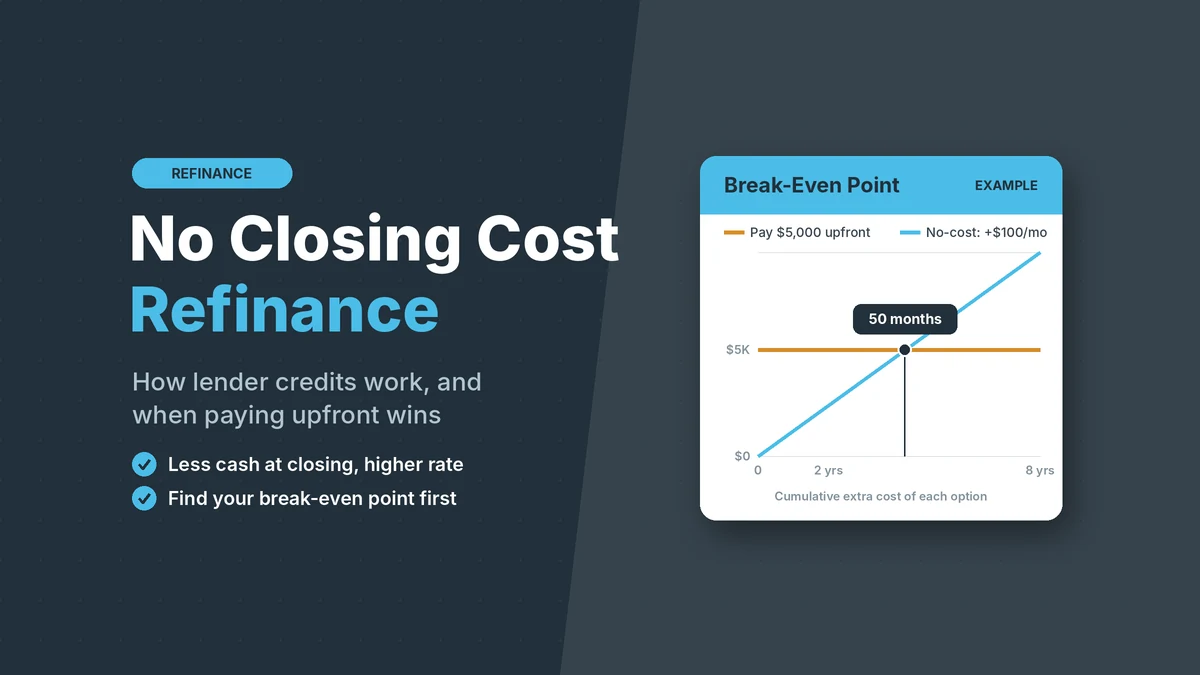
Comparing a traditional refinance with a no-cost option comes down to one question: how long until the monthly savings from the lower rate make up for what you paid upfront?
Here’s a hypothetical example:
| Lower-rate refinance | No-cost refinance | |
|---|---|---|
| Eligible closing costs paid upfront | $5,000 | $0 |
| Monthly payment difference | Baseline | $100 more |
| Upfront cash preserved | $0 | $5,000 |
In this simplified version, the no-cost option runs you an extra $100 a month.
Break-even calculation:
$5,000 ÷ $100 = 50 months
So it takes roughly 50 months, or four years and two months, for the lower payment on the upfront-cost option to cover its $5,000 starting expense.
Planning to sell or refinance again in two years? Then hanging onto that $5,000 now could make the no-cost option the better pick. If you’re likely to keep the mortgage for eight years, paying upfront will probably save you more.
Keep in mind this is just an illustration, not a real loan quote. A full comparison should factor in actual rates, payments, loan balances, any financed expenses, and how long you expect to keep the mortgage. It also assumes that $100 difference stays the same the whole time. We can help you make an informed decision about your finances at DG Funding.
“Aren’t No-Cost Refinances Just Hiding the Cost?”
It’s a fair question. The honest answer: the cost gets covered or moved somewhere else. It doesn’t disappear.
That doesn’t make a lender-credit refinance a bad idea. It can make good sense when having cash on hand matters more to you than getting the lowest rate available. Someone doing a cash-out refinance, for example, might want to keep money for renovations, investments, running a business, or emergency savings, instead of spending several thousand dollars at closing.
The same goes for a homeowner who expects to move or refinance again fairly soon. A lower rate may not save them enough to earn back the upfront costs.
There’s a catch, of course. Keep the mortgage past the break-even point, and the higher-rate option may end up costing more. And financing your costs raises what you owe, which could affect your future equity and how easily you can refinance down the road.
So the real question isn’t “Which option has no closing costs?” It’s closer to “What will each option cost me over the time I expect to keep this loan, and how much cash do I need to hold onto right now?”
California Refinancing and Non-QM Considerations
What you need from a refinance in California can look pretty different depending on whether you’re doing a rate-and-term refinance or taking cash out.
A rate-and-term refinance is mostly about changing your interest rate, your loan term, or both. A cash-out refinance swaps your current mortgage for a bigger loan, and eligible borrowers can take part of their equity as cash, within program limits and underwriting.
What works best depends on the whole transaction. Not just what the home is worth, and not just the payment you’d like to see.
If you’re a non-QM borrower, the details matter even more. Self-employed homeowners, business owners, and real estate investors may qualify through alternative documentation or specialized programs. But pricing, whether lender credits are available, which fees count as eligible, and underwriting requirements can all differ from conventional financing.
Not every lender or non-QM program offers the same no-cost setup, either. Your credit profile, loan size, property type, occupancy, loan-to-value ratio, and other factors can change what’s on the table.
That’s why actual written offers will tell you a lot more than a general online estimate.
Compare Cost and No-Cost Options with DG Funding
Before you refinance, put two scenarios next to each other:
- Pay costs upfront: Find the lower rate, the monthly payment, what you’ll spend upfront, and how long it takes to break even.
- Use lender credits: Look at the higher rate, which expenses get covered, any cash still due at closing, and what it’ll likely cost over the time you plan to keep the loan.
Then step back and think about what you’re actually after. Lowering your monthly payment? Getting at your equity? Protecting business capital? Setting yourself up for a move later on?
At DG Funding, we help California homeowners look at refinance options with those goals in mind. The point is to understand the trade-offs before you commit, rather than assuming the lowest rate or the lowest upfront cost is automatically the right call.
Request a personalized comparison through DG Funding’s website and our team will help. Bring your approximate loan balance, your current rate, an estimate of your property’s value, and what you want the refinance to do for you. We’ll look at the structures available to you, walk you through the costs and lender credits, and help you work out your break-even point.
Or, if you’d rather start on your own, try a break-even calculator to get a rough idea of how long upfront costs would take to pay for themselves.
A no-closing-cost refinance can be a smart move when the numbers back it up. Just make sure you know what you’re trading, and that the trade fits your plans.