

Plenty of businesses bring in solid revenue. That doesn’t mean a traditional mortgage application will see it that way. Tax deductions, depreciation, and ordinary business expenses can make the taxable income on your return look nothing like what’s actually moving through your company.
So if you own a business and want to buy property, refinance, or pull out some equity, two alternative documentation options are worth comparing: a profit and loss (P&L) loan and a business bank statement loan.
Either one can help an eligible self-employed borrower qualify without relying only on tax returns and W-2s. They just look at your business finances in different ways.
Which one makes more sense comes down to a few things. How well do your financial statements reflect what you really earn? How steady are your deposits? And how does the lender handle your expenses?
P&L Loan vs. Business Bank Statement Loan: What’s the Difference?
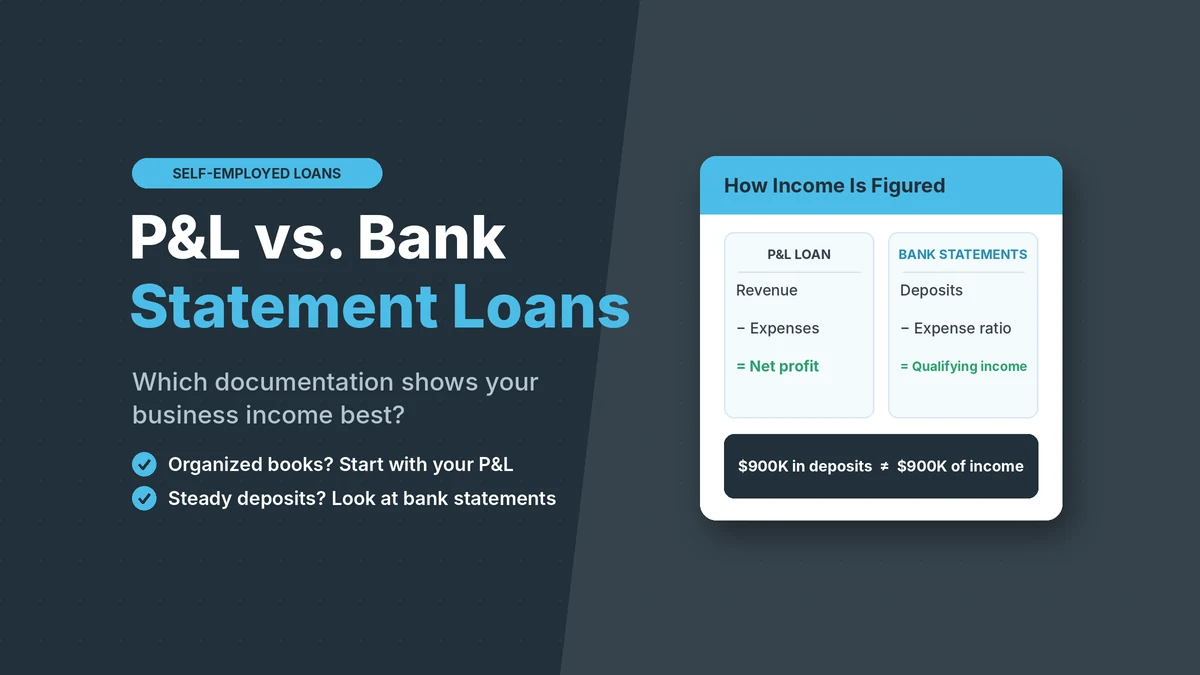
With a P&L loan, the lender uses your profit and loss statement to look at revenue and expenses. Some programs will also accept a letter from a CPA verifying the relevant financial details.
A business bank statement loan starts somewhere else: the deposits going into your business accounts. Deposits aren’t the same as profit, though. So the lender usually applies an expense ratio, or another approved method, to estimate your qualifying income.
Here’s a quick side-by-side:
| Consideration | P&L loan | Business bank statement loan |
|---|---|---|
| Primary evidence | P&L statement and supporting documentation | Business bank statements |
| Typical lookback | Current year-to-date plus 12-24 months of prior information, as required | Commonly 12-24 months, depending on the program |
| How income is evaluated | Revenue and expenses shown in the P&L | Deposits, adjusted for business expenses using the lender’s method |
| CPA involvement | May provide a P&L or letter verifying financial facts | May still be relevant to supporting business information, depending on the program |
| Potential advantage | Useful when business financial records clearly demonstrate cash flow | Useful when bank deposits provide a clear picture of business activity |
| Potential concern | Weak bookkeeping, unexplained changes, or high operating costs | Irregular deposits, overdrafts, unexplained transfers, or an unsuitable expense ratio |
Neither option is guaranteed to get you a higher qualifying income or a better rate. What you’re really trying to figure out is which method gives the most accurate picture of your business under a lender’s rules.
A Practical Decision Tree: Which Option Fits Your Business?
Four questions will get you most of the way there.
1. Are your books current, organized, and consistent?
If your P&L does a good job tracking revenue and operating expenses, a P&L-based program is probably the first place to look. The lender can see how income and expenses relate to each other instead of going off taxable income alone.
Maybe your books don’t show cash flow very well, but your business deposits are well documented. In that case, bank statement financing might deserve a closer look.
2. Do your deposits reflect your actual business activity?
Steady deposits tend to make a bank statement application easier to evaluate. But not every deposit counts as revenue. Transfers between your own accounts, loan proceeds, refunds, and other non-operating money may need an explanation. Some may be treated differently.
Lots of unexplained deposits, or big swings from month to month? Go through your statements before you decide this is the better route.
3. How do your operating expenses affect the picture?
With a P&L loan, the lender looks at the revenue and expenses shown in the statement.
With a business bank statement loan, the lender usually applies an expense ratio to cover overhead. If your expenses run unusually high or unusually low compared with the ratio they assume, ask how that changes the income calculation.
4. What loan amount and transaction are you planning?
Your loan amount, credit profile, the property, your down payment, and your reserves can all affect which programs make sense. What works for one borrower might not be the best fit for someone going after a bigger mortgage or a cash-out refinance.
The practical rule: lead with the documentation that best shows your financial position. Then compare the actual programs available for what you’re trying to do.
Two Examples: How the Numbers Can Change
Here are two made-up business owners. They show how the decision works. They don’t promise any particular underwriting result.
Example A: Strong bookkeeping, predictable expenses
A consulting business brings in $600,000 a year. The current P&L is well kept, operating expenses are clearly documented, and the records are consistent.
There are also plenty of business deposits. Some of those are transfers between accounts, and they’d need to be identified.
Here, a P&L approach gives a fairly clear starting point, since revenue and expenses are already organized. The lender can review that documented picture against its program guidelines.
Could a bank statement approach still work? Sure. The owner would just need to sort out which deposits count and see how the lender’s expense ratio affects qualifying income.
Example B: High deposits, significant overhead
A contractor’s business takes in $900,000 in deposits a year. A big chunk goes right back out for materials, subcontractors, payroll, and other operating costs.
That $900,000 isn’t the owner’s qualifying income. A lender reviewing the bank statements has to account for what it cost to bring that revenue in.
A P&L could lay out those costs in detail. A bank statement program might still work too, as long as its expense method fits the business and the qualifying income that comes out of it meets program requirements.
Both examples end up in the same place: high revenue or large deposits alone don’t establish mortgage-qualifying income. How the lender does the math matters.
What Documentation Will You Need?
Whichever way you go, getting your paperwork ready early can save some back-and-forth.
For a P&L loan with DG Funding, we suggest borrowers may need a current year-to-date P&L, generally prepared within the last 60 days. You may also need prior financial information covering one or two years, depending on the program, and possibly a CPA-prepared statement or letter.
That CPA letter, sometimes called a comfort letter, can verify things like business ownership, how long you’ve been in business, and income. It may also address whether pulling a down payment out of the business would hurt it. The CPA is reporting and verifying information. The letter doesn’t guarantee future performance or mortgage approval.
For a business bank statement loan, gather the 12-24 months of business account statements. Be ready to explain returned payments, overdrafts, odd deposits, and transfers that could make your business activity hard to read.
For either option, it helps to have these organized:
- Business ownership information
- Current financial records
- Credit information
- Property details
- Your target loan amount
How long processing takes depends on how complete your documents are, how complex your business is, and what underwriting requires. One approach isn’t automatically faster than the other. Clean records and quick replies do help you avoid delays you don’t need.
Can You Compare or Combine Documentation Options?
You don’t have to pick a loan structure before you talk to DG Funding. It can actually help to have both your P&L and your business bank statements on hand so we can see which route suits your situation.
Can different kinds of documentation be considered together? That depends on the program and its underwriting rules. Don’t assume combining methods is allowed, and don’t assume it would raise your qualifying income if it were.
Also think about the overall cost of financing. Alternative-documentation mortgages are very different from traditional loans, so it’s important to understand what decisions mean both for now and the future. Your credit, the loan amount you ask for, and your overall financial position all shape the terms you’re offered.
Compare with DG Funding
If your business earns more than your tax returns seem to show, picking the right documentation path can be an important first step toward a mortgage.
DG Funding can look over your business finances and talk through whether a P&L-based program, a business bank statement loan, or another eligible option is worth exploring for your purchase, refinance, or cash-out plans.
Contact our team to talk about your situation. For an initial review, have your current P&L, the relevant business bank statements, a rough loan amount, and your transaction goals ready.
Think about our simple decision tree above to compare the two routes. How good are your books? How consistent are your deposits? What does your expense structure look like, and what financing do you need?
The right mortgage starts with an accurate picture of your business finances. Compare your options before you commit to one.