

When the property you’re financing costs a million dollars or more, the monthly mortgage payment becomes something you plan around, not something you just pay. If you’re a high-net-worth homeowner, a business owner, or a real-estate investor, paying the loan down as fast as possible isn’t always the priority. Often the more useful question is how much capital you want to keep free for a business need, another investment, or simple liquidity.
A 40-year fixed interest-only mortgage is one way to approach that. For an initial period, it can bring your required monthly payment down while leaving more of your cash available. That lower payment has a price, and you’ll mostly feel it later, once principal repayment begins. So, let’s look at all parts before you decide whether the structure fits.
How Does a Jumbo Interest-Only Mortgage Work?
The idea is fairly simple. For an initial interest-only period, eligible borrowers pay the interest on the loan and nothing toward principal. The balance stays where it started.
Programs differ, but you may be able to compare 30-year and 40-year fixed-rate structures, some of which include a 10-year interest-only period.
The “fixed rate” part causes some confusion. It fixes your interest rate. It doesn’t fix your payment for the life of the loan. When the interest-only period ends, you usually start repaying principal, and your payment rises even though the rate hasn’t changed.
For a large mortgage, that makes this mainly a cash-flow decision: where your money goes each month, and when. A smaller payment is the result, not the purpose.
How Much Lower Could Your Monthly Payment Be?
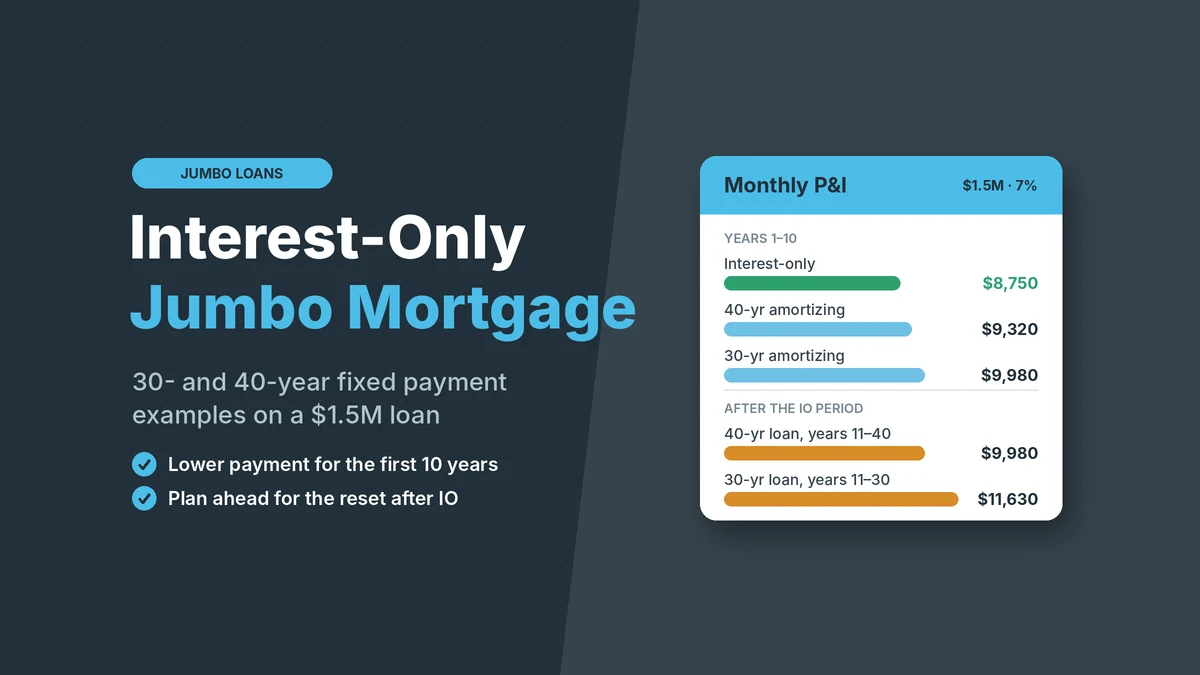
Take a hypothetical $1.5 million jumbo mortgage at a fixed annual rate of 7%. Here’s how an interest-only payment compares with fully amortizing loans at the same rate:
| Mortgage structure | Approx. monthly payment |
|---|---|
| Interest-only at 7% | $8,750 |
| Fully amortizing over 30 years | $9,980 |
| Fully amortizing over 40 years | $9,320 |
In this example, the interest-only payment is about $1,230 lower per month than the 30-year amortizing payment. That’s around $14,760 over a year.
Compared with the 40-year amortizing loan, the difference shrinks to roughly $570 a month. That’s still noticeable, just less dramatic.
These figures are illustrative and cover principal and interest only. Taxes, insurance, fees, and other property costs aren’t included, and your real terms and payments will depend on the program.
The $8,750 payment also has a clear limit: it doesn’t reduce the $1.5 million balance at all. The money you save stays available to you, but none of it pays down the loan.
What Happens After the 10-Year Interest-Only Period?
This is the part to plan for early, well before year nine.
Suppose your $1.5 million loan has a 40-year total term with a 10-year interest-only period. If the full balance is still owed after year 10 and is repaid over the remaining 30 years at 7%, your principal-and-interest payment rises to about $9,980 a month.
That’s an increase of around $1,230 a month, starting in a single month.
The 30-year version is tighter. With 10 years interest-only, the balance usually gets amortized over the remaining 20 years. At the same illustrative rate, the payment would be close to $11,630 a month.
The exact schedule depends on your loan agreement. Before signing, ask whether the program includes a scheduled payment reset, recast provisions, a different amortization schedule, or any other terms that could change your future payments.
A lower initial payment only makes sense if you have a plan for the later payment and outstanding principal.
Who Might Benefit from an Interest-Only Mortgage?
In general, this structure works best when you have a specific reason to keep liquidity high. For example:
- High-net-worth homeowners who prefer to keep capital within reach instead of putting extra cash into principal now.
- Business owners who need funds on hand for working capital or growth, or whose income comes in unevenly.
- Real-estate investors spreading money across several acquisitions or managing more than one property.
- Borrowers refinancing or taking cash out who are comparing payment structures while deciding what to do with the equity they free up.
It’s probably a weaker fit if you want to see your balance go down every month, if you’d rather have a steady, predictable amortizing payment, or if the higher payment after the interest-only period would strain your budget.
Qualifying is a separate step. Eligibility depends on the program, the property, your credit profile, your assets, and underwriting requirements.
Is the Lower Payment Actually Worth the Trade-Off?
That depends mostly on what you do with the money you don’t spend on principal.
In the $1.5 million example, you start out paying about $1,230 a month less than you would on a 30-year amortizing loan. Over 10 years, that’s roughly $147,600 in lower scheduled payments, assuming the illustrative rate and structure don’t change.
That $147,600 isn’t savings in the full sense. Over the same decade, the amortizing borrower has been reducing their balance. The interest-only borrower still owes the full $1.5 million, unless they made extra principal payments.
To compare fairly, look beyond the monthly number and consider:
- The outstanding balance
- Total interest paid
- Future payment obligations
- Fees
- What the extra liquidity is actually worth to you
If you plan to invest the difference, be cautious. Returns aren’t guaranteed, and counting on them to beat your mortgage cost is a bet. Base your break-even analysis on the actual loan terms and on what you really plan to do with the money, not on a best-case scenario.
Compare Your Payment Structures with DG Funding
A jumbo interest-only mortgage isn’t right for everyone. If liquidity and capital allocation are high priorities for you, though, it deserves a serious look.
DG Funding works with borrowers on purchases, refinances, and cash-out transactions. We can help you compare the structures you’re eligible for, show you what your payment will be after the interest-only period, and weigh the trade-offs against your financial goals.
Use an IO payment comparison calculator, then request a personalized review with DG Funding. Allow us to help you work through your own numbers, including loan amount, proposed term, interest-only period, and expected future payment.
A lower payment million-dollar mortgage can help. Over the long run, what matters more is a mortgage that fits the rest of your financial plan, and we’re glad to help you find one.