

Financing an Airbnb or Vrbo is not quite like financing a standard long-term rental. Nightly rates move around. Occupancy depends on the season, and also on the town, since a ski area and a beach area rarely peak in the same month. Last year’s numbers may not tell you much either. If the previous owner used the place as a family getaway for a few weeks each summer, its history says very little about what it could earn. Anyone who has bought a short-term rental before has probably run into the real problem, which is that a lot of loan programs aren’t built for how these properties work.
A short-term rental DSCR loan can be a practical way to buy an investment property. It also works for refinancing a mortgage you already have, or for pulling out equity. At DG Funding, we start with the property and what it can realistically bring in. Then we look at the deal you’re trying to do and work out which financing options make sense.
How Does an Airbnb DSCR Loan Work?
DSCR stands for debt-service coverage ratio. It compares a property’s eligible rental income to its qualifying debt obligations. In other words, personal tax returns aren’t required or even considered.
The math itself is simple:
DSCR = Eligible rental income ÷ qualifying property debt obligations
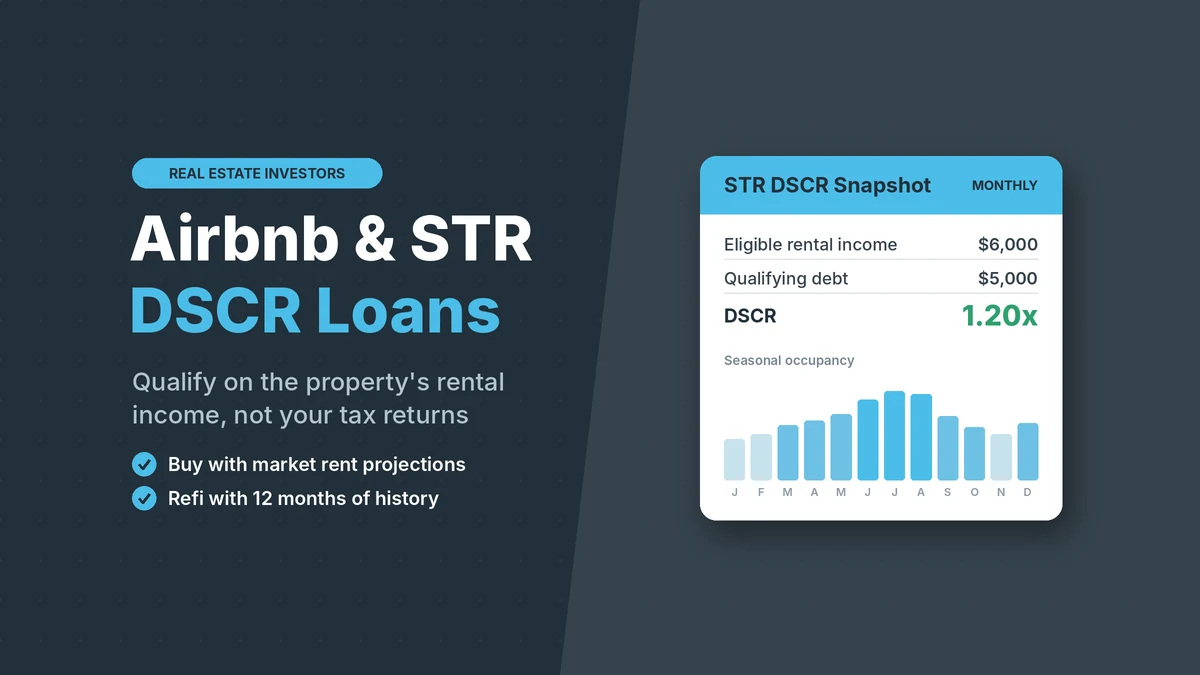
So $6,000 in eligible monthly rental income against $5,000 in qualifying monthly debt gives you a DSCR of 1.00x.
Conventional mortgages lean hard on your personal income. DSCR financing cares more about whether the investment property can carry its own debt. If you own several rentals, that difference adds up quickly. The same goes if you’d prefer to skip the usual personal-income paperwork, or if your tax returns (after depreciation does its thing) make you look less well-off than you are.
It isn’t a blank check, though. The lender decides which income and expenses count, and you still have to clear the program’s minimum DSCR.
Buying an Airbnb Property: How Are Rental Projections Evaluated?
When you’re buying, there usually isn’t 12 months of operating history under your name. You don’t own the place yet. But that doesn’t automatically rule out DSCR financing.
Depending on the lender and program, you may be able to qualify with comparable market rents and short-term rental market analysis instead of the property’s own rental record.
Take a furnished home in a popular Southern California destination. You’d want a feel for nightly rates in peak season and in the off months, plus how much occupancy actually drops after Labor Day. Then there are the comparable listings on Airbnb or Vrbo. Some of them get booked steadily. Others just sit there looking lovely in their photos, and it’s worth knowing which kind you’re comparing yourself to.
AirDNA loan qualification and similar tools help with this. You can research estimated revenue, occupancy, and how the local market has been performing. The estimates are useful. But they’re estimates, not guaranteed income, and not every lender will take them at face value.
What it comes down to is whether your evidence supports the income calculation your specific DSCR program requires.
Before you make an offer, think through:
- Whether the comparable properties genuinely resemble the one you’re buying
- How seasonality affects occupancy and nightly rates
- Whether local rules permit the short-term rental use you have in mind
- Which rental projections and supporting documents the lender will accept
The local rules question trips up more buyers than you’d guess. Permits, zoning, and owner-occupancy requirements vary a lot from city to city. Sorting this out early tells you whether the financing is realistic while you can still walk away.
Refinancing an Established Airbnb or Vrbo: Why Rental History Matters
A refinance starts from a different place. You’ve been running the property already, so the lender has actual performance to look at rather than forecasts.
Under the program requirements that apply to your scenario, 12 months of rental history may be required for a refinance. A full year covers the good stretches and the slow ones. One packed July doesn’t say much about February.
Records that help include Airbnb or Vrbo earnings statements, booking histories, and rental income summaries. The lender may also ask for other financial documents.
Here’s where people get caught. Gross bookings aren’t necessarily the same as eligible rental income for DSCR purposes. Platform fees, operating costs, vacancy assumptions, and the lender’s own calculation method all play into the figure that’s used, and the qualifying number often lands below what your host dashboard shows.
Cash-out refinancing adds more to think about. Say you want to release equity to fund another property or investment. How much you can take out depends on the property’s value, your existing mortgage balance, the permitted LTV, and other program requirements.
It’s usually clearest to look at your operating history and your current equity side by side. That tends to narrow down which options are worth pursuing.
Calculate Your Property’s DSCR: A Simple Example
Suppose you’re evaluating a short-term rental with these hypothetical figures:
| Item | Monthly amount |
|---|---|
| Eligible rental income | $6,000 |
| Qualifying property debt obligations | $5,000 |
| DSCR | 1.20x |
Divide $6,000 by $5,000, and you get 1.20x. Eligible monthly rental income, in other words, is 20% higher than qualifying monthly debt.
As a first screen, that’s helpful. It isn’t a full profitability analysis. Your real cash flow also gets chipped away by cleaning, management, utilities, maintenance, insurance, property taxes, platform fees, and the weeks when nobody books.
Lenders don’t all calculate DSCR the same way, either. One program might count an expense that another ignores. Some start from gross rents, and some use a different qualifying income figure altogether.
Use an STR DSCR calculator to estimate your property’s coverage and flag questions to sort out before you request financing. Treat the result as an initial estimate. It’s not an approval decision.
What Makes a Short-Term Rental DSCR Loan Application Easier?
A question we hear a lot: do I need to know the exact loan program before I talk to a lender? You don’t have to figure that out on your own. Matching the property to a program is part of what we do at DG Funding.
That said, having some details ready makes the first review go further:
- Property address and intended short-term rental use
- Purchase price or estimated current value
- Proposed loan amount and existing mortgage balance, if there is one
- Expected rental income for a purchase, or documented rental history for a refinance
- Whether you’re purchasing, refinancing, or looking for cash out
- Any rental analysis, platform statements, or comparable property data you already have
DG Funding works through multiple lending channels, which lets us look at options across different programs, subject to availability and underwriting. That matters more than it might sound. A mountain cabin and a downtown condo share a lockbox and not much else, so assuming they fit the same lending criteria usually goes badly. We’d rather find a route that suits your particular property.
Review Your STR Property with DG Funding
Maybe you’re buying your next Airbnb. Or you’ve had a Vrbo running for a while, and it’s time to refinance, or you’d like to pull equity out for another investment. Whatever the plan, the property’s DSCR is a good place to start. One of the biggest draws for many is that personal tax returns aren’t required.
It also matters whether you’re working from projected market rents or documented rental history. That shapes which financing options fit and what evidence you’ll need to provide.
Request a review of your short-term rental property with DG Funding. Share the property details, your proposed loan amount, and whether you’re planning a purchase, refinance, or cash-out. If you have rental projections or 12 months of operating history, include those as well.
From there, we’ll measure your scenario against the applicable program requirements and help you figure out which next steps are worth taking.